Historic Property #1: Episcopal Church of Our Saviour
Address: 2979 Coloma Street
Year Built: 1865
Architect: William Patton
Builder: O. Taylor
Architectural Style: Gothic Revival
The Episcopal Church of Our Saviour holds the distinguished title of the oldest continually-occupied church building in El Dorado County. The parish’s roots trace back to July 1861, when Reverend Charles Caleb Peirce organized the congregation, initially holding services in the old Courthouse. By 1864, the congregation sought a permanent home. The women of the church organized a three day fair that netted $1,200 to purchase a Coloma Street lot, notably the former site of a circa 1853 Presbyterian Church. When construction funds fell $1,500 short, four local saloon keepers famously canvassed the town, raising the remaining balance in a single afternoon.
Constructed in 1865 for $10,500, the striking Gothic Revival edifice was designed by prominent San Francisco architect William Patton and built by local contractor O. Taylor. The structure boasts several ingenious architectural features. Its vaulted ceiling is supported by an inverted clipper ship frame, a technique utilizing the marine building practices of former San Francisco shipwrights. To achieve a heavy, stone like Gothic effect using only wood, builders constructed a second wall three feet inside the exterior, giving the tall windows the illusion of being set deep within thick masonry. High above, the original bell cast in Boston in 1850 and shipped around the Horn still rings every Sunday.
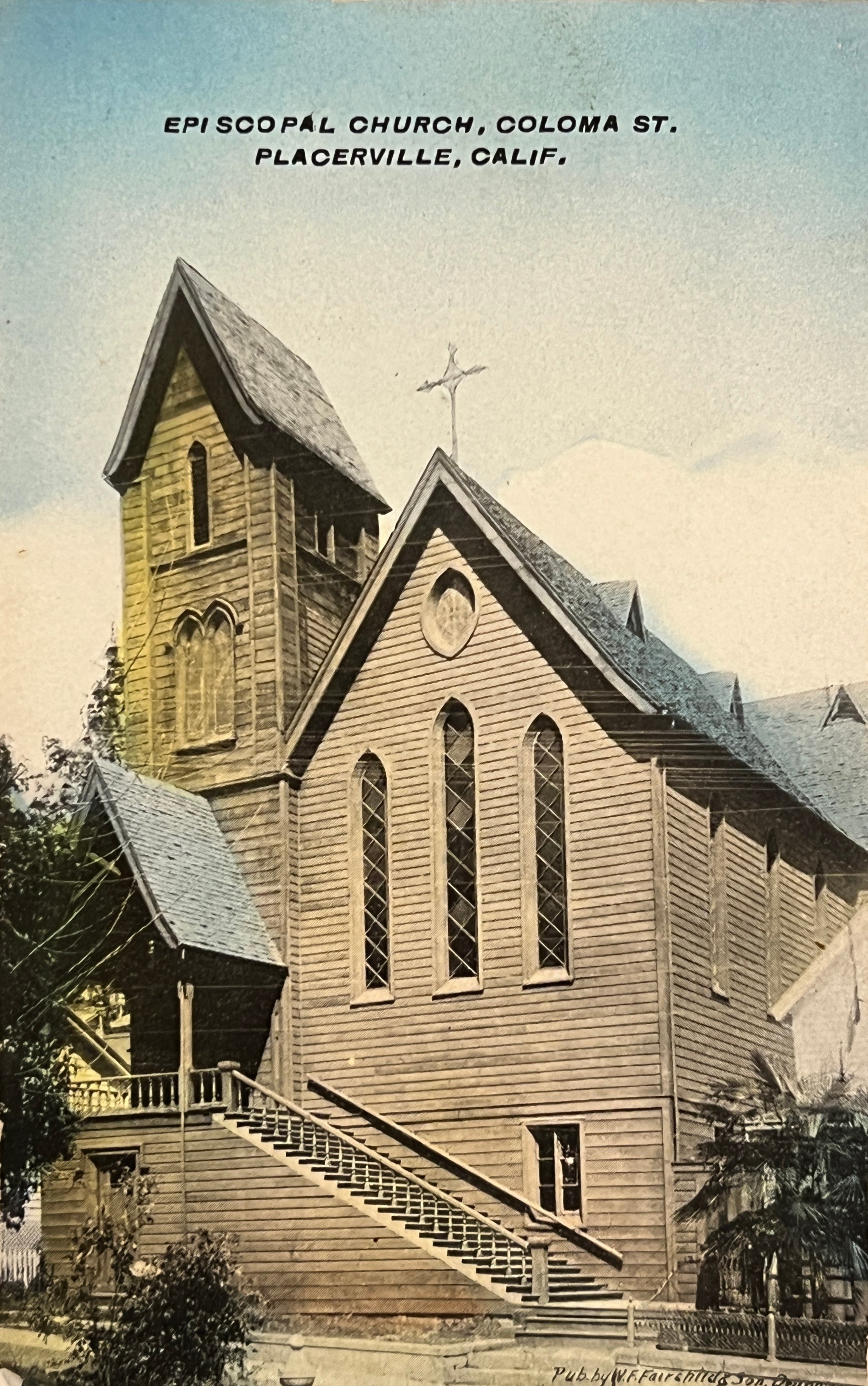
Images courtesy of the Bruce & Laurie Maclin Collection; property of Jacob Rigoli & Sean Manwaring.
The church's enduring spirit is anchored by Reverend Peirce, affectionately known as the "Apostle of El Dorado County." For 42 years, he traversed the rugged county on foot to minister to remote mining camps and settlements. He never accepted a salary, relying entirely on the community for his living expenses while also serving as the City Superintendent of Schools. When he passed away in March 1903, Placerville's schools, businesses, and even its saloons closed their doors to honor his memory.
Over the decades, dedicated community restorations have preserved this architectural treasure. In 1927, high school shop teacher Silvio Ronzone led a major structural overhaul of the foundation and undercroft. Ronzone and his students contributed again during a 1938 restoration, crafting the sanctuary's beautiful wood paneling, altar rail, and credence table right in the school shop. Recognized for its profound architectural and cultural significance, the building was officially added to the National Register of Historic Places in the 1970s.